
Biodiversity Credits: A Promising Benchmark or Just a Trend in Conservation Finance?

Indonesia is known as one of the most biodiverse countries in the world. However, this natural wealth continues to face various threats, from land-use change and natural resource exploitation to climate change, all of which affect the survival of wildlife, forests, and ecosystems. Amid these growing threats, the funding needed to protect nature remains far greater than the resources available. This gap has driven the emergence of various innovative financing mechanisms, one of which is biodiversity credits.
In recent years, biodiversity credits have attracted growing attention as an alternative way to finance conservation efforts. Unlike carbon credits, which focus on reducing or removing greenhouse gas emissions, biodiversity credits aim to provide economic incentives for activities that deliver tangible benefits to biodiversity. But is this mechanism truly ready to become a solution to the global biodiversity crisis?
A Market Still in Its Early Stages
The scientific article Biodiversity Credit Schemes: A Comparative Analysis by Croci et al. (2025) examines several biodiversity credit schemes (BCSs). The study shows that the biodiversity credit market is still in its early stages of development. Of the 68 schemes identified, only 15 met the criteria for further analysis. Most of the remaining schemes were still under development, lacked sufficient documentation, or focused more on offsets or combined carbon and biodiversity credits.
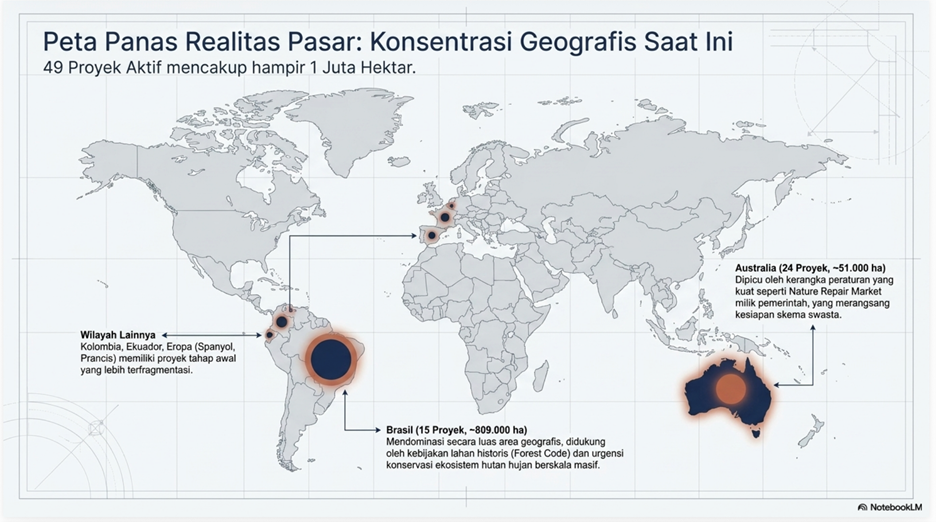
To date, only 10 schemes have entered the implementation stage, covering a total of 49 projects, while another 19 projects remain under development. In terms of issuance, approximately 11.66 million biodiversity credits are planned for issuance, but only around 5.79 million have actually been issued. Of these, only about 124,000 credits have been sold, and a small proportion have been retired. These figures suggest that the market is still evolving and has yet to reach maturity.
Who Is Driving the Market?
Contrary to the assumption that governments are the main actors, most biodiversity credit schemes are actually developed by the private sector. Governments lead only a small proportion of these schemes, while various non-governmental organizations and companies contribute to developing methodologies and projects, conducting certification, and facilitating credit trading.
This ecosystem involves a wide range of stakeholders, including standards developers, scheme administrators, independent auditors, project developers, landowners, Indigenous Peoples and Local Communities (IPLCs), brokers, traders, and end buyers. Each plays an important role in ensuring that conservation benefits are genuinely delivered and can be held accountable.

Not Just Nature, but People Too
The involvement of local communities is receiving increasing attention. Most schemes require community consultation, while some even mandate the application of the principle of Free, Prior and Informed Consent (FPIC). Other schemes allocate a portion of project revenues to local communities or conservation activities.
This approach is important because successful conservation depends not only on ecological conditions but also on the support of communities living alongside conservation areas.
Despite its promise, however, biodiversity credits still face several fundamental challenges:
1. Inconsistent Standards
Each scheme uses different methods to measure conservation outcomes. Some assess biodiversity based on species, habitats, or ecosystem services. These differences make credits from different schemes difficult to compare, reduce market transparency, and potentially undermine the credibility of the mechanism as a whole.
2. Inconsistent Governance
Regulatory gaps, weak enforcement, and a lack of independent verification remain significant concerns. These conditions create opportunities for greenwashing, in which a project claims to deliver greater conservation benefits than it actually achieves on the ground. In addition, securing Indigenous Peoples' land rights and ensuring fair benefit-sharing remain important challenges.
3. An Unstable Market
Biodiversity credit prices vary widely, market liquidity remains low, transaction costs are high, and trading infrastructure is still underdeveloped. Various solutions have been proposed, including government-led price stabilization mechanisms, the involvement of market makers, greater transparency among market intermediaries, and the development of more effective trading platforms.
Integrity Is Key
For biodiversity credits to deliver genuine benefits for nature, they must be underpinned by high integrity. Projects need to demonstrate that their conservation outcomes are genuinely additional (additionality), can be sustained over the long term (permanence), and do not shift negative impacts to other locations (non-leakage). They must also be supported by robust monitoring, reporting, and verification systems, as well as independent audits. Transparency throughout the entire process is equally essential.
Opportunities for Indonesia
As a megadiverse country, Indonesia has significant potential to use biodiversity credits as a source of conservation financing. However, the success of this mechanism will depend not only on the country's natural wealth but also on its ability to establish credible standards, transparent governance, and meaningful community involvement as a key part of conservation efforts.
Biodiversity credits are more than just an economic instrument. If designed well, they could serve as a bridge between conservation and development. Without strong standards and adequate oversight, however, they risk becoming little more than a green label without any meaningful impact on nature.
The greatest challenge today, therefore, is not simply to create more biodiversity credits, but to ensure that every credit represents real, measurable, and lasting conservation benefits.
Reference
Croci, E., Lucchitta, B., & Cusa, M. (2025). Biodiversity credit schemes: A comparative analysis. Journal of Cleaner Production.

 Oleh Admin


