
Modeling Bengal Slow Loris Habitat: Where Can They Still Survive?

Have you ever heard of the Bengal slow loris? Or do you know where this species lives in the wild?
The Bengal slow loris (Nycticebus bengalensis) is a nocturnal primate that is active at night and spends most of its life in trees. This species can be found across various forest ecosystems in South and Southeast Asia. Its distribution ranges from Bangladesh, Bhutan, and India to southern China, Myanmar, Cambodia, Laos, Vietnam, and Thailand.
The Bengal slow loris is easily recognized by its large eyes, slow and deliberate movements among tree branches, and its lighter coloration compared to other slow loris species. Despite its adorable appearance, the Bengal slow loris faces serious threats in the wild. In 2020, its conservation status was upgraded to Endangered by the International Union for Conservation of Nature (IUCN). Population declines have been driven by several factors, including forest loss, habitat fragmentation, hunting, and illegal wildlife trade.
Southern Assam forms part of the Indo-Burma biodiversity hotspot. This region contains a diverse landscape consisting of tropical forests, hills, agricultural land, and human settlements. To better understand Bengal slow loris habitat preferences, researchers used habitat suitability modeling with MaxEnt software. This approach enables scientists to predict potential habitats based on species occurrence records and environmental variables.
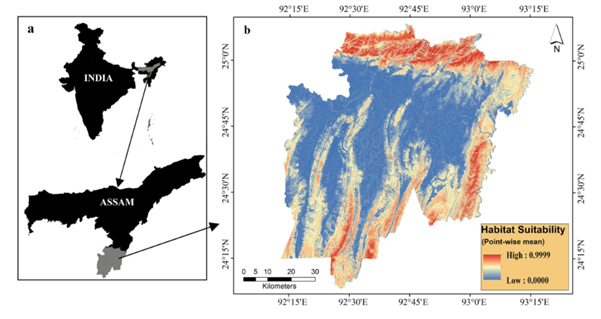
The study was conducted over 15 months using a combination of nocturnal field surveys, interviews with local communities, and satellite image analysis. Through this process, researchers collected dozens of Bengal slow loris occurrence points, which were analyzed alongside various environmental factors.
The results showed that forest structure was the most important factor influencing Bengal slow loris occurrence. The species was more frequently found in large, relatively intact forest areas. Vegetation health also played a crucial role. Areas with dense vegetation, measured using the Normalized Difference Vegetation Index (NDVI), were generally preferred because they provide food resources and shelter. Forest structure and NDVI were the dominant contributors to the habitat model, accounting for 35.7% and 34.5% of the model contribution, respectively.
The habitat suitability model revealed that the most suitable habitats for Bengal slow lorises are relatively intact forests, including evergreen tropical rainforests, semi-evergreen forests, and deciduous forests. These findings are consistent with previous field studies showing that such forest types provide essential food resources and refuge for the species. In addition to feeding on tree gum, fruits, and other plant materials, Bengal slow lorises also prey on small animals such as insects, lizards, small birds, and eggs.
The study further found that Bengal slow lorises are more commonly encountered in areas with dense and healthy vegetation. Besides vegetation condition, other factors such as elevation, slope, and distance from roads, settlements, and agricultural land also influenced their occurrence. In general, Bengal slow lorises were more frequently found in forested areas located around 500 meters above sea level, characterized by relatively steep terrain and limited human disturbance.

Through habitat modeling, this study demonstrates that parts of Southern Assam still provide suitable conditions for Bengal slow lorises. These findings are valuable for researchers and conservation managers in identifying priority conservation areas and designing more effective habitat protection strategies for the species. By understanding where the most suitable habitats remain, conservation efforts can be focused on the areas most critical for the long-term survival of the Bengal slow loris.
Read the full study here: https://doi.org/10.1007/s10329-021-00967-x

 Oleh Admin

