
The Unseen Little Things That Keep Coffee Delicious

Every time we enjoy a cup of coffee, what comes to mind might be the farmers tending to the trees, the barista brewing it, or the distinct aroma wafting from the cup. Yet, long before the coffee reaches our hands, so much life has played a part. Shade trees keep the coffee plants cool, insects help with pollination, and wildlife helps maintain the ecosystem's balance. There are even invisible creatures that are also part of the coffee's journey.
Have you ever heard someone say, "I want to drink coffee, but I can't"? Or perhaps you've experienced it yourself. After just one cup, your heart starts beating faster, your hands feel a little shaky, or it's hard to close your eyes until late at night. For some, a cup of coffee might be a companion to start the day, but for those sensitive to caffeine, it's often a dilemma: do I really have to stop drinking coffee?
As it turns out, not necessarily. The answer actually comes from an almost invisible world: microbes that live around coffee plants and play a role in the fermentation process.
When Caffeine Becomes a Dilemma
Caffeine is the main reason why billions of people are willing to wake up early for a cup of coffee. It stimulates the nervous system, wards off sleepiness, improves focus, and for many, becomes an essential part of their daily routine. However, the body's response to caffeine is not always the same. Some people can enjoy several cups of coffee without a problem, while others start feeling uncomfortable side effects after just one or two cups. This is what makes caffeine a dilemma for some coffee lovers.
Ironically, caffeine is actually the coffee tree's own defense weapon. This compound protects young leaves and fruit from pests and pathogens, while also inhibiting the growth of other plants around it. The very same compound that keeps us awake in the morning is a natural shield built by the coffee tree over millions of years of evolution.
The demand for low-caffeine coffee continues to grow. A survey of over twelve thousand consumers found that thirteen percent of them only drink decaf coffee or coffee that has undergone a caffeine reduction process, while another twenty-seven percent consume both. This trend is getting stronger, especially among young consumers who are increasingly health-conscious.
Interestingly, most consumers are not looking for completely caffeine-free coffee. They still want the same coffee-drinking experience, just with a milder stimulant effect. It is this challenge that has pushed researchers to find new ways to reduce caffeine without losing the flavor character that forms the coffee's identity.
The problem is, the methods traditionally used to remove caffeine almost always come at a cost.
Choosing Between Healthy, Delicious, or Cheap
The Swiss Water Process, which is the most popular method, can indeed remove up to ninety-nine percent of caffeine. But the process is not selective: aroma-forming compounds are also discarded, and the coffee's flavor evaporates right along with them. Chemical solvent methods are more effective but leave concerning residues. Meanwhile, supercritical carbon dioxide technology is considered safe and precise, but it requires high-tech equipment that is unaffordable for most coffee farmers.
In practice, many decaffeination methods still force producers to compromise between flavor quality, production costs, and caffeine removal effectiveness. The challenge is finding an approach capable of balancing all three. Is there really no other way?
This is where the story gets interesting.
Long before humans thought of ways to remove caffeine from coffee, microscopic creatures had already been doing it naturally. Several types of microbes, single-celled organisms that live in soil, water, and on the surface of coffee cherries, are able to use caffeine as a source of carbon and nitrogen to survive. In the process, caffeine is broken down into much simpler, harmless compounds.
A study published in the journal Foods in 2025 identified at least 121 microorganisms with the ability to degrade caffeine, consisting of eighty bacteria species, thirty-three fungi, and eight yeast species. Most of these names might sound foreign. But some of them are already very familiar in everyday life: Saccharomyces cerevisiae, the same yeast used to make bread, beer, and wine. Or Lactobacillus, the bacteria working behind every spoonful of yogurt you eat.
More Than Just Reducing Caffeine
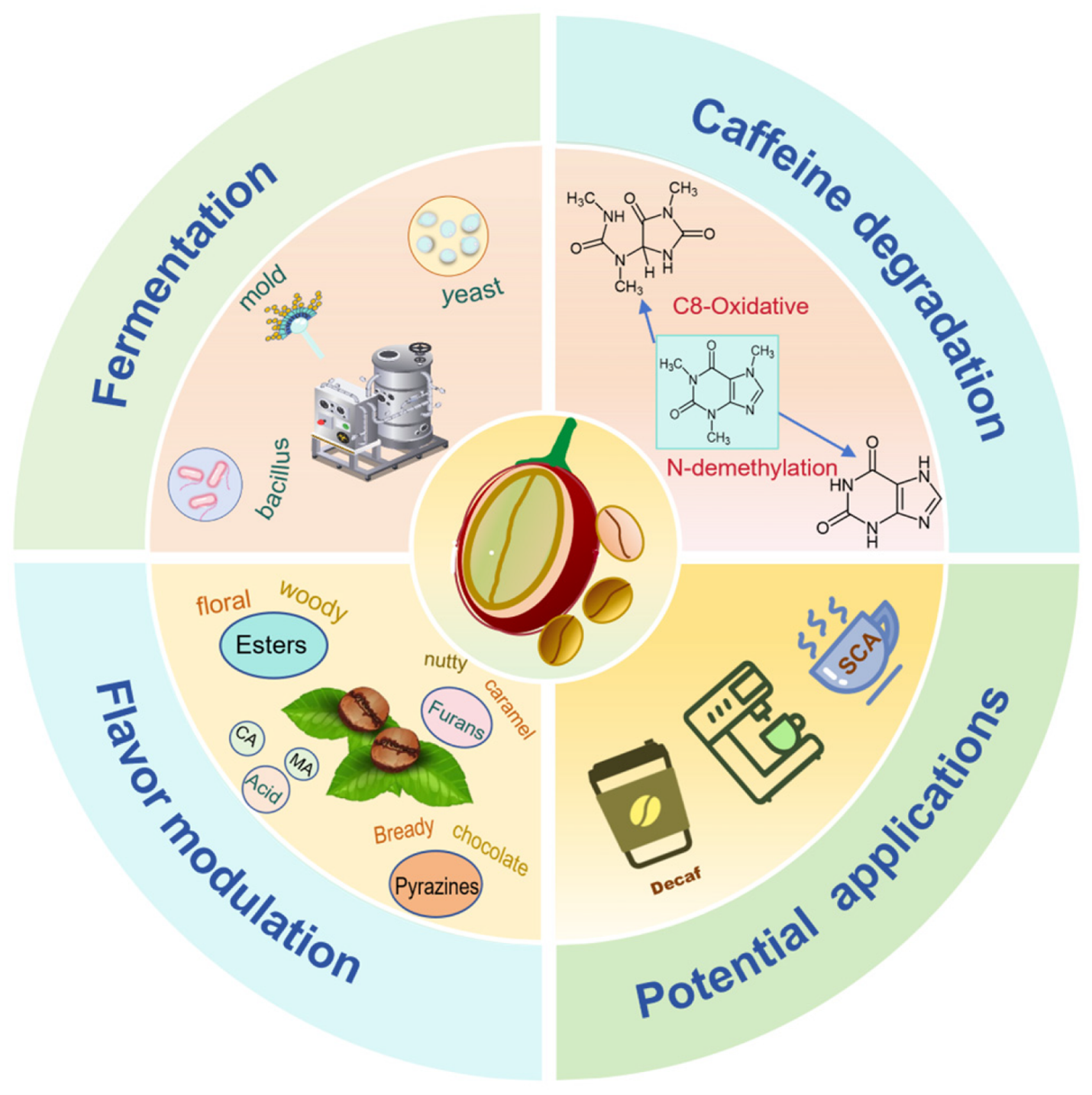
What makes this approach truly different from conventional methods is its dual benefit.
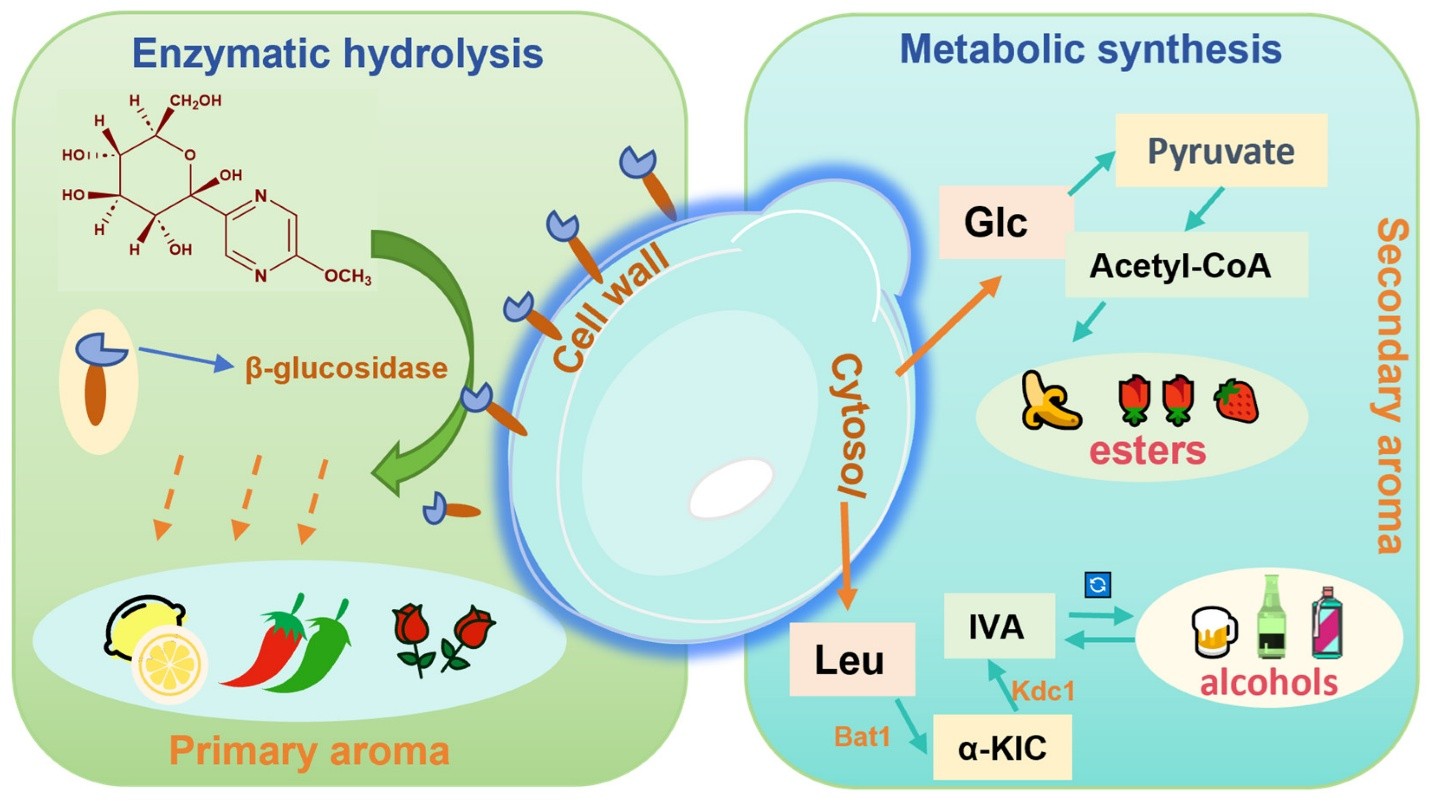
When microbes work on coffee beans, they don't just break down caffeine. They also break down sugars, proteins, and various organic compounds in the coffee cherry, ultimately producing new aroma compounds as byproducts. In other words, this method doesn't merely reduce something unwanted; it actually adds something valuable.
Research shows that a combination of several types of microbes produces coffee that is much richer than using just one type. When Lactobacillus is combined with Saccharomyces cerevisiae, they work like a mutually reinforcing team. Saccharomyces helps provide various compounds that support the metabolism of Lactobacillus. Conversely, Lactobacillus produces lactic acid which lowers the pH of the fermentation environment. This interaction helps form a more stable fermentation process while encouraging the formation of various aroma and flavor compounds.
The result is often associated with a more complex flavor profile, ranging from chocolate, caramel, and spices, to fruity and floral notes, depending on the fermentation conditions used.
However, not every story goes quite that smoothly.
Not all caffeine-degrading microbes are safe for consumption. Certain fungal species can produce mycotoxins, which are toxins harmful to health. Process control is also a crucial stage. The ideal fermentation temperature is in the range of twenty to thirty degrees Celsius with near-neutral acidity. Fermentation that lasts too long or at too high a temperature won't produce caramel, but rather an unwanted vinegar taste and metallic aroma.
Science has already opened the door. But its application still requires caution.
From the Laboratory to the Coffee Farm
Herein lies the good news for Indonesia as one of the world's largest coffee producers.
Microbial fermentation technology does not require a sophisticated laboratory or large capital. Researchers even note that fermentation can be done with simple equipment like airtight plastic bags, and coffee waste such as the skins (husks) and pulp can be utilized as fermentation media.
In Indonesia, various microbial culture-based fermentation experiments are beginning to attract the attention of specialty coffee players. This approach opens up opportunities to produce coffee with more consistent flavor characters while simultaneously increasing added value at the farmer level.
In the future, it is entirely possible that the best cup of coffee will no longer be born from high-pressure machines in large factories, but rather from the collaboration between farmers, science, and billions of unseen microbes at work. These tiny creatures ask for nothing. They only need a little space, a little time, and the right coffee beans.
They'll take care of the rest.
Reference
Ran, L.-X., Wei, X.-Y., Ren, E.-F., Qin, J.-F., Rasheed, U., & Chen, G.-L. (2025). Application of Microbial Fermentation in Caffeine Degradation and Flavor Modulation of Coffee Beans. Foods, 14, 2606.

 Oleh Admin

